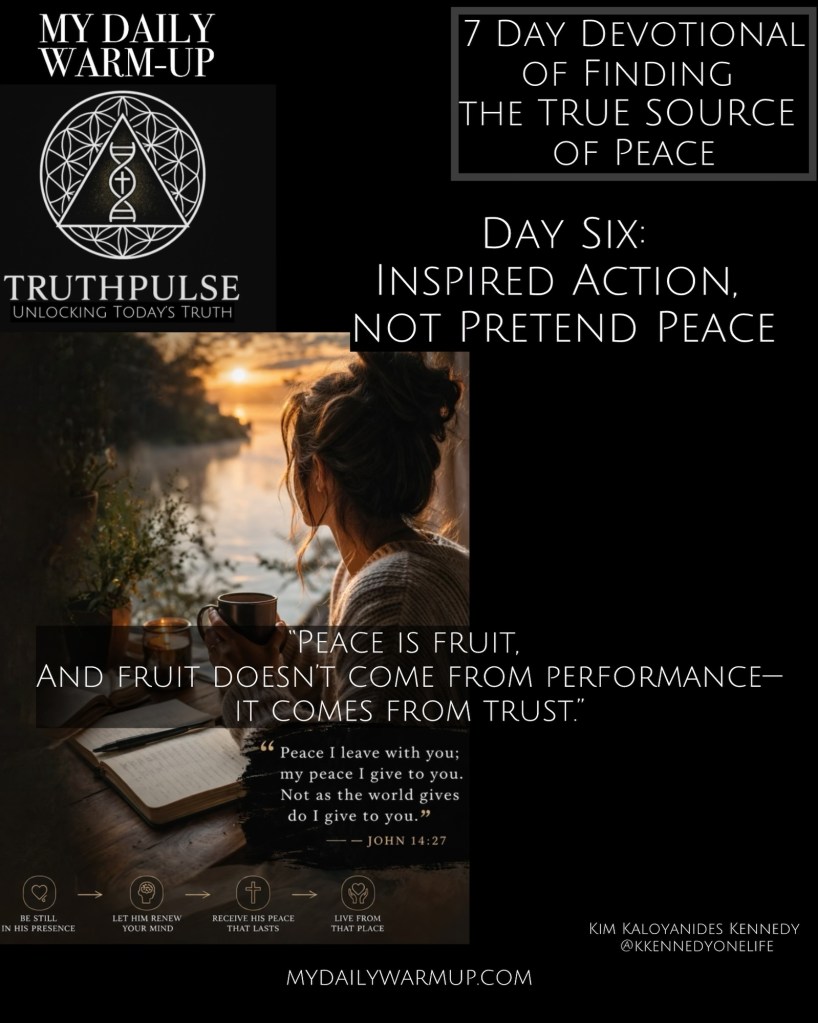
Scripture
“Peace I leave with you; my peace I give to you. Not as the world gives do I give to you.”
— John 14:27
Devotional
There is a difference between performative calm and real peace.
Pretend peace avoids discomfort, suppresses emotion, and tries to look composed. True peace can coexist with tears, uncertainty, and deep need because it is rooted in the nearness of Christ, not the perfection of circumstances.
Peace is not sitting there saying “Ohm” 251 times and then returning to real life with dread and heaviness. It’s not avoiding or doing nothing. It involves taking the next right action in alignment with what is most important to you, no matter the circumstances, being connected to God’s purpose for you and to God Himself.
Inspired action flows naturally from God’s peace. It is not frantic striving. It is not white-knuckled self-improvement. It’s not finishing all the checkboxes ✅ and still feeling empty or not enough. It is the next right thing done with God.
Inspired action may look like apologizing, resting, worshiping, setting a boundary, going for a prayer walk, turning off the noise, asking for help, opening your Bible, or simply sitting quietly with the Lord before doing anything else.
From a Musician’s Perspective
Musicians can become experts at pretending-looking composed while internally unraveling. We know how to hold posture, smile politely, not flinch when something goes wrong so to not SEEM like anything actually was wrong 😑 and perform under pressure—even while the nervous system is surging underneath. But outward composure is not always inward peace.
Pretend peace is seeming.
It’s searching for just a hint of calm while trying to convince yourself—and everyone else—that you’re fine. It’s managing the appearance, tightening control, hoping if you just do everything “right,” the feeling will follow.
But peace doesn’t work like that.
It’s either there… or it’s not.
It’s not something you fake until you make.
It’s not something you manufacture through effort.
Peace is fruit.
And fruit doesn’t come from performance—it comes from trust.
In music, we often confuse control with peace.
We think:
If I prepare enough…
If I lock everything in…
If I eliminate every variable…
then I’ll feel steady.
But we’ve all experienced the opposite.
Standing on stage.
Heart racing.
Hands shaking.
And we wonder, “Why don’t I feel peaceful? I did everything right.”
And here’s what I’ve come to see—
It’s normal to shake.
Our bodies respond to pressure, to exposure, to meaning.
That in itself isn’t wrong.
But I’ve also experienced something else.
Moments where I should have been shaking…
moments where I used to shake…
and I didn’t.
Not because I tried harder to control it.
Not because I forced calm.
But because something in me was anchored differently.
When my focus shifts—
from myself… to the message,
from fear… to love,
from proving… to offering—
everything changes.
My hands don’t fight me the same way.
My body doesn’t surge in the same direction.
Because peace isn’t being manufactured…
it’s being received.
And in those moments, there’s a quiet knowing:
I’m not here to impress.
I’m here to communicate, to share.
I’m here to give what’s already been given to me.
And that…
that is what alignment feels like.
Not the absence of intensity—
but the presence of something deeper than it.
So yes, shaking is human.
But peace?
Peace has a different signature.
And I’m starting to recognize it—
not by how perfectly I perform…
but by how deeply I trust.
In music, pretend peace can look like:
over-controlling every detail to avoid exposure
shutting down emotionally to “get through”
perfectionism disguised as excellence
trying to appear unaffected
It looks strong.
But underneath, it’s fragile.
Because it depends entirely on me holding it together.
Real peace is different.
It doesn’t come from gripping tighter.
It comes from releasing deeper.
Inspired action isn’t less serious—it’s more surrendered.
It may look like:
slowing down a passage instead of forcing it
asking a better question instead of proving
receiving feedback without collapse
stepping away before saying something I would regret
listening to really hear
praying before I play
choosing to share rather than impress
Because true peace doesn’t come from mastering the music alone.
It comes from knowing:
I am not the only one holding the moment together.
 The My Daily Warm-Up Studio
Leave a comment